
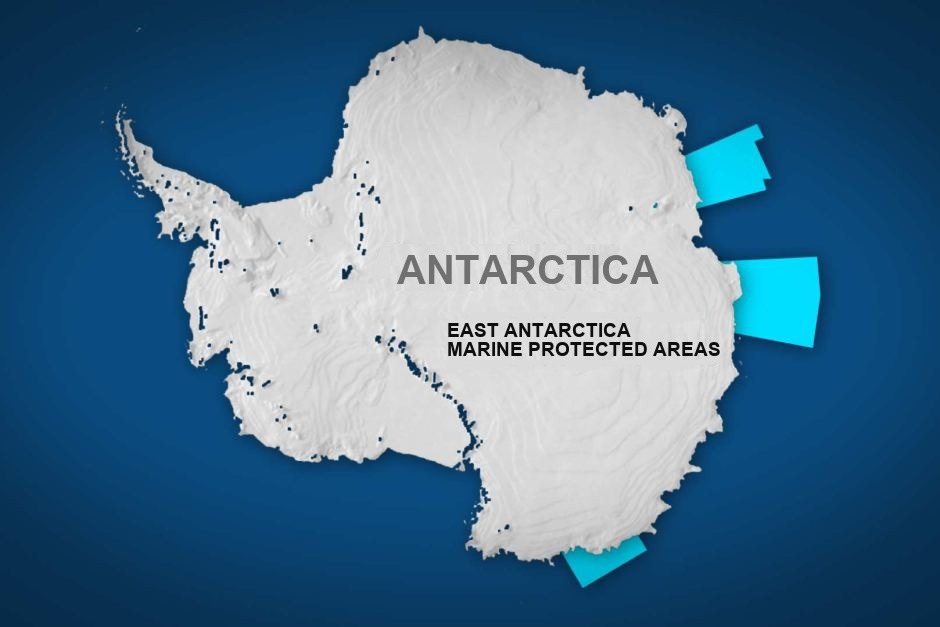
In 2019, the proposed East Antarctic marine park failed to win approval for the eighth time. This marine protected area (MPA) off the coast of East Antarctica would cover a vast stretch of the Southern Ocean: almost one million square kilometres.
The decision lies with the European Union and the 24 countries that made up the Commission for the Conservation of Antarctic Marine Living Resources (CCAMLR) in 2019. They meet every year in Hobart, Tasmania. CCAMLR was set up under the Convention on the Conservation of Antarctic Marine Living Resources, which came into force in 1982, to conserve marine life in the Antarctic while allowing its rational use. The convention is part of the Antarctic Treaty System, which sets the international rules for activities in Antarctica.

The protected area is meant to safeguard the habitats of penguins, seals, whales and seabirds. To show just how beautiful these habitats are, here is a short video.
In 2019, the talks again took place behind closed doors, but according to participants, Russia and China were once more to blame. The two countries have blocked the proposal every year so far, and approval requires consensus among all members. Their reasons are political and economic: both countries want to develop industrial fishing in the area, above all Antarctic krill fishing. As well as polluting the sea with lost fishing nets, industrial fishing could destabilise an ecosystem that depends on Antarctic krill (Euphausia superba).
According to Italian marine biologist Marino Vacchi, a long-standing member of Italy’s delegation to the CCAMLR Scientific Committee, quoted by the Italian daily Corriere della Sera, fishing boats in the region target two kinds of catch. One is krill, a small marine crustacean at the centre of the Southern Ocean food chain, which large predators such as whales feed on. The other is toothfish: two closely related, cod-like fish, one found only around Antarctica (Antarctic toothfish) and the other also in other waters (Patagonian toothfish).
To protect these fish as far as possible, CCAMLR requires scientific observers on board toothfish vessels and, by 2019, on at least three-quarters of krill vessels. However, illegal fishing vessels also sail these waters. Vacchi says they usually fly the flags of countries such as Panama or Liberia, and large international fishing companies hide behind them. CCAMLR has introduced satellite monitoring to stop them, but the vessels often change their flag, colour and appearance, so a group of experts works out which parts of a ship cannot be changed. According to Vacchi, vessel controls improved greatly over the previous eight years.

Krill are the main food of the animals here, and a shortage could trigger the destabilisation of the Antarctic ecosystem mentioned above. People use krill as aquarium food, as bait for anglers, in cooking and even in health supplements (mainly krill oil).
Krill feed mainly on phytoplankton, including the algae that grow on the underside of sea ice. Because of climate change, there is less and less of this ice, and so less food for krill. Research suggests that krill are already in trouble in parts of the Southern Ocean: in the south-west Atlantic, their range has shrunk southwards over the past 90 years as the region has warmed (Atkinson et al., 2019). As krill sit near the base of the food chain, their decline affects the animals at every level above them.
Status of Antarctic marine protected areas in 2019
By the end of 2019, CCAMLR had approved only two of the five proposed marine parks around Antarctica:
- South Orkney Islands – 94,000 km² – approved (2009)
- Ross Sea – 1,550,000 km² – approved (2016)
- East Antarctica – about 950,000 km² – not approved (proposed since 2012)
- Weddell Sea – about 1,800,000 km² – not approved (proposed since 2016)
- Antarctic Peninsula – about 670,000 km² – not approved (proposed since 2018)

On the map, these areas may look small, but they are distinct, fragile ecosystems that need protection from fishing. Mining is already banned throughout Antarctica under the Environmental Protocol to the Antarctic Treaty.
The Ross Sea marine protected area, which covers about 12% of the Southern Ocean, was agreed in 2016 and has been in force since December 2017 for an initial period of 35 years. In 2052, CCAMLR members will have to agree by consensus whether to renew or change it.
A no-take zone, where all fishing is banned, covers 72% of the park. In the remaining 28% – the research zones – only certain species may be caught, and only for research. Other marine protected areas are likely to be divided in a similar way.

The negotiations are very difficult because they have to balance several interests. Vacchi says the convention now has to find a compromise between a level of fishing that does not threaten ecosystems and the interests of its member countries and fishing companies.
For an even more detailed view of the areas, with a key, see CCAMLR’s interactive map. We can only hope that the remaining protected areas will be approved as soon as possible. Update (November 2026): CCAMLR’s October 2026 meeting again ended without agreement on any new marine protected area, so the South Orkney Islands and Ross Sea parks are still the only two (ASOC).
🌿 Worth sharing? Let others know!
Enjoyed this article? Share this article or our page on Facebook, Instagram, or Threads. You’ll help us bring eco-tips and guides that save both money and the environment to many more people. Together, our impact will be much greater.
It takes literally just a few seconds, but it makes a huge difference for our planet. Thank you in advance for sharing:
 Facebook
 Instagram
 Threads
📩 Never miss a tip! Follow us
For the latest updates, we recommend joining our WhatsApp channel or following us on Pinterest. We promise to post at most one article every two days, so we won’t spam or disturb you.
⚠️ Important: On WhatsApp, click the bell icon to ensure you get notified.
 Join WhatsApp
 Follow Pinterest
Sources: The Guardian, Wikipedia, CCAMLR, Atkinson et al. (2019), ASOC (2026)