

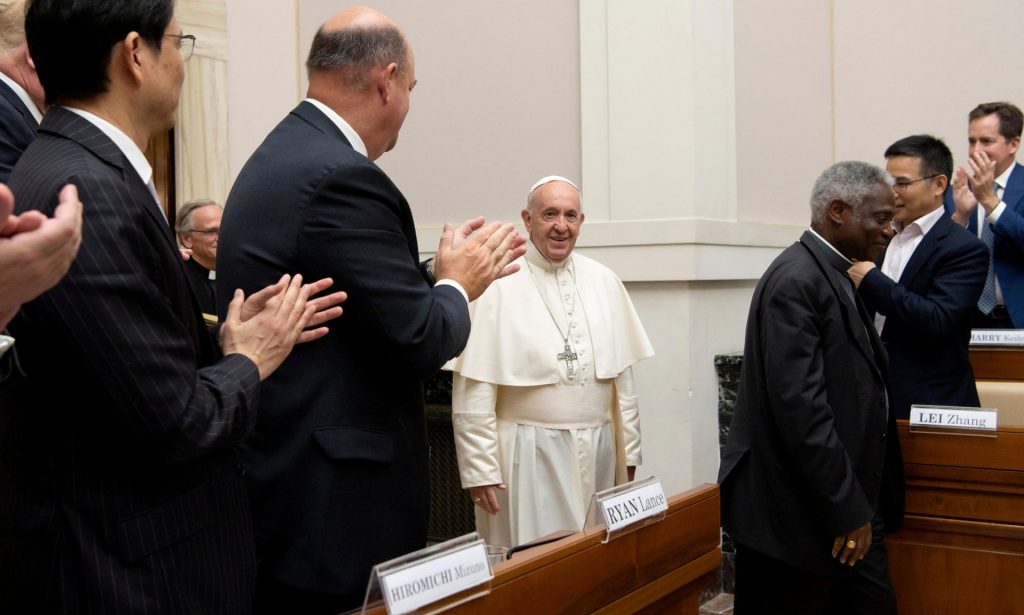
Pope Francis, head of the Catholic Church, met executives, investors and experts from the oil and gas industry at the end of a two-day conference at the Vatican (13–14 June 2019), titled “The Energy Transition and Care for Our Common Home”.
The meeting with the Pope took place on a Friday, the day that has become synonymous with Fridays for Future, the climate strikes organised by young people around the world.
“Dear friends, time is running out! Deliberations must go beyond mere exploration of what can be done and concentrate on what needs to be done, starting today. We do not have the luxury of waiting for others to step forward, or of prioritizing short-term economic benefits. The climate crisis requires ‘our decisive action, here and now’ and the Church is fully committed to playing her part,” Francis said.
The Pope was referring to the Intergovernmental Panel on Climate Change’s 2018 Special Report on Global Warming of 1.5 °C. As he put it, the report warns that the effects will be catastrophic if warming goes beyond 1.5 °C, and that “only one decade or so remains” to limit it. Scientists also warn that further warming can set off feedbacks in which nature itself releases more greenhouse gases, for example methane from thawing permafrost and more extensive wildfires.
Discussions among representatives of global oil and gas companies and investors focused on three linked topics: a just transition to a low-carbon society, carbon pricing and transparency in reporting climate risk.
Pope Francis noted that a just transition “involves managing the social and employment impact of the move to a low-carbon society”. He was confident that this could be done:
“If managed well, this transition can generate new jobs, reduce inequality and improve the quality of life for those affected by climate change. Second, carbon pricing is essential if humanity is to use the resources of creation wisely. The third issue, transparency in reporting climate risk, is essential because economic resources must be deployed where they can do the most good.”
Chief executives and chairs of BP, ExxonMobil, Shell, Total, ConocoPhillips, Chevron and several major investors, including BlackRock and Hermes Investment Management, responded by calling on governments to introduce carbon pricing to encourage low-carbon innovation. They also called for greater transparency in reporting climate risk so that investors can make informed decisions.
In two statements at the end of the two-day Vatican meeting – addressed by the Pope and led by senior church officials – the signatories called for “a combination of policies and carbon pricing mechanisms designed in a way that simultaneously delivers innovation and investment in low-carbon solutions while assisting those least able to pay” – that is, those least able to afford a carbon tax.
The meeting produced no pledges to cut greenhouse gas emissions and set no timetable for action, so it was left to each participant to decide how to respond. Even so, we all surely realise that sooner or later we will have to switch to other sources of energy. What matters is making that shift in time, and the statements from oil company executives offer some hope.
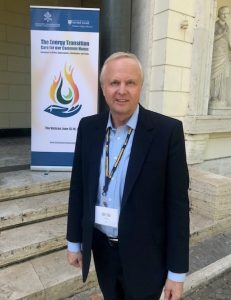
Bob Dudley, then chief executive of BP, said after the Vatican meeting: “The world needs to take urgent action to get us on a more sustainable path and it is critical that everyone plays their part – companies and investors, governments and individuals. This requires all of us to come together, build understanding and collaborate to find solutions. Constructive dialogues such as this meeting are essential in aligning key players on the steps needed to accelerate the energy transition while still enabling advances in human prosperity. I am grateful to his Holiness for continuing to support this critical engagement.”
Mark Campanale, founder and executive director of the Carbon Tracker Initiative, said: “We must forego business-as-usual protocols and short-term market-driven goals or face environmental and financial ruin of catastrophic proportions. Oil and gas companies have a crucial role to play in transitioning to a low-carbon economy but must today collectively take those hard decisions in the wake of determined investor and public pressure, and unambiguous scientific evidence.”

The Pope stressed that it is the poor who suffer the worst impacts of the climate crisis, even though poorer countries have contributed least to global warming.
“As current situations demonstrate, the poor are those most vulnerable to hurricanes, droughts, floods and other extreme climatic events. […] At the same time, future generations stand to inherit a greatly spoiled world. Our children and grandchildren should not have to pay the cost of our generation’s irresponsibility.”
“I beg your pardon, but I would like to emphasize this: they, our children and grandchildren should not have to pay – it is not right that they should pay – the price of our irresponsibility. Indeed, as is becoming increasingly clear, young people are calling for change. Today’s young people are saying, ‘The future is ours’, and they are right!”
Three things are essential if the energy industry is to complete the transition quickly enough: a carbon tax; a higher carbon price, so that renewable energy becomes the cheaper option; and investment from these taxes and other sources in technologies to replace fossil fuels.
Humanity has the means and the time to change, so let us hope it succeeds, whether we are Christians or not. We all have an interest in ensuring that future generations inherit a habitable world, one without hunger or a lack of drinking water, and without dangerous extremes of weather such as tornadoes, hurricanes, droughts and floods.
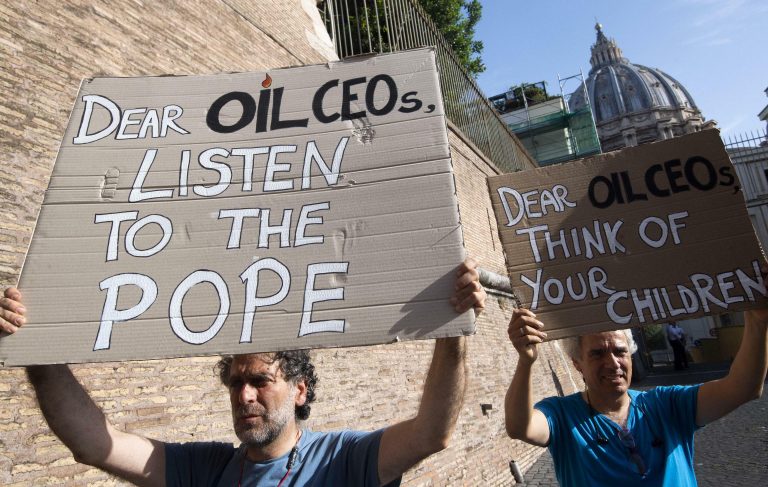
Outside the Vatican gates, a small group of students from Fridays for Future Rome held a banner reading “Dear Oil CEOs: listen to the Pope”. They wanted the executives not only to listen to the Pope but, above all, to act on what had been agreed.
You can do your bit to tackle climate change through your own everyday choices. For practical ideas, read these 10 low-cost tips to help fight climate change.
Update: Pope Francis died on 21 April 2025, at the age of 88.
🌿 Worth sharing? Let others know!
Enjoyed this article? Share this article or our page on Facebook, Instagram, or Threads. You’ll help us bring eco-tips and guides that save both money and the environment to many more people. Together, our impact will be much greater.
It takes literally just a few seconds, but it makes a huge difference for our planet. Thank you in advance for sharing:
 Facebook
 Instagram
 Threads
📩 Never miss a tip! Follow us
For the latest updates, we recommend joining our WhatsApp channel or following us on Pinterest. We promise to post at most one article every two days, so we won’t spam or disturb you.
⚠️ Important: On WhatsApp, click the bell icon to ensure you get notified.
 Join WhatsApp
 Follow Pinterest

Sources: The Guardian, Holy See Press Office (full text of the Pope’s address), Al Jazeera